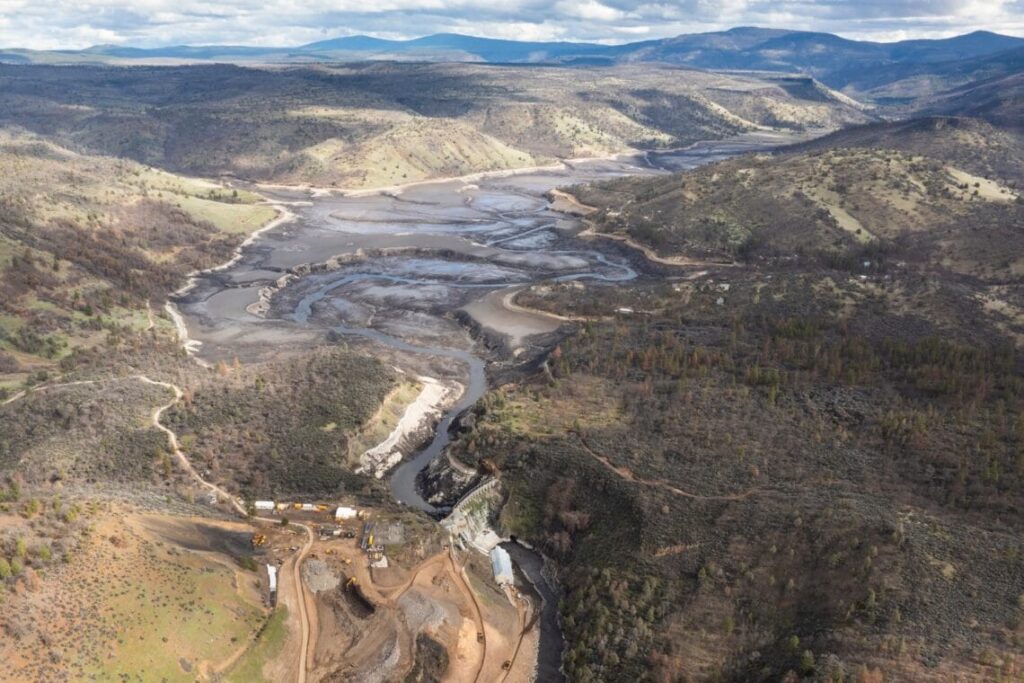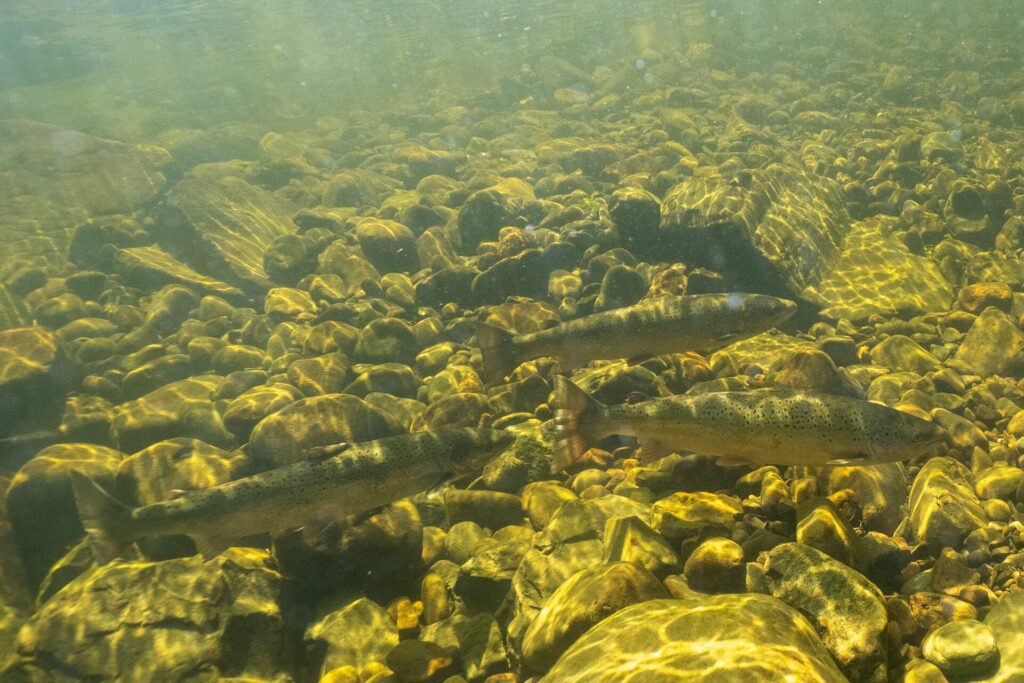
A Biological Opinion (BiOp) recently produced by the National Oceanic and Atmospheric Administration (NOAA) has determined that continued operation of Englebright dam and Daguerre Point dams on the lower Yuba River in California will jeopardize endangered fish species on the Yuba River.
Source:
Transactions of the American Fisheries Society
Volume:
136
Year:
2007
Abstract
A warming climate could profoundly affect the distribution and abundance of many fishes. Bull trout Salvelinus confluentus may be especially vulnerable to climate change given that spawning and early rearing are constrained by cold water temperatures creating a patchwork of natal headwater habitats across river networks. Because the size and connectivity of patches also appear to influence the persistence of local populations, climate warming could lead to increasing fragmentation of remaining habitats and accelerated decline of this species. We modeled the relationships between (1) the lower elevation limits of small bull trout and mean annual air temperature and (2) latitude and longitude across the species’ potential range within the interior Columbia River basin of the USA. We used our results to explore the implications of the climate warming expected in the next 50 or more years. We found a strong association between the lower elevation limits of bull trout distributions and longitude and latitude; this association was consistent with the patterns in mean annual air temperature. We concluded that climate does strongly influence regional and local bull trout distributions, and we estimated bull trout habitat response to a range of predicted climate warming effects. Warming over the range predicted could result in losses of 18–92% of thermally suitable natal habitat area and 27–99% of large (.10,000-ha) habitat patches, which suggests that population impacts may be disproportionate to the simple loss of habitat area. The predicted changes were not uniform across the species’ range, and some populations appear to face higher risks than others. These results could provide a foundation for regional prioritization in conservation management, although more detailed models are needed to prioritize actions at local scales.
Author(s)
Rieman, Bruce E.; Isakk, Daniel; Adams, Susan; Horan, Dona; Nagel, David; Luce, Charles; Myers, Deborah
Source:
United Nations Environment Programme
Volume:
Year:
2010
Abstract
Damming a river may bring electric power, but it often comes at the price of high-quality food fisheries, experts say. When dams are proposed for power, flood control or irrigation, the often devastating impacts on fisheries in rivers and lakes are ignored or discounted.
This report by the UN Environment Programme (UNEP) and the World Fish Centre warns that despite over 40 years of steady production globally, rapid environmental changes are occurring which challenge the viability of future fish stocks and a range of internationally- agreed development targets including the Millennium Development Goals.
The report is available online at http://www.unep.org/pdf/Blue_Harvest.pdf
Author(s)
Dugan, P., Delaporte, A., Andrew, N., O'Keefe, M., Welcomme, R.
Source:
CVPIA
Volume:
Year:
2008
Abstract
This report prepared by the Bureau of Reclamation and the US Fish and Wildlife Service in December 2008 analyzes the Central Valley Project Improvement Act (CVPIA) and its impacts on increasing the populations of anadromous fish in Central Valley rivers and streams. The CVPIA (1992) had a goal of doubling the population by 2002, which didn't happen. The report claims that this goal will not be achieved unless renewed commitments and improvements are made to the program.
Author(s)
Cummins, Ken; Chris Furey; Albert Giorgi; Steve Lindley; John Nestler; John Shurts
Source:
Volume:
Year:
2008
Abstract
A independent science panel review concludes that the California's Central Valley Project Improvement Act's salmon doubling program has failed to achieve its goal for the number of reasons. The panel also makes a number of recommendations.
Author(s)
Cummins, Ken; Chris Furey; Albert Giorgi; Steve Lindley; John Nestler; John Shurts
After years of debate on the fate of former hydroelectric dams on the Boardman river in Michigan, it has been decided that three of the four existing dams will be removed.
Source:
Journal of the American Water Resources Association
Volume:
45-1
Year:
2009
Abstract
We evaluated the impact of land cover on fish assemblages by examining relationships between stream hydrology, physicochemistry, and instream habitat and their association with fish responses in streams draining 18 watersheds of the Lower Piedmont of western Georgia. Several important relationships between land use and physicochemical, hydrological, and habitat parameters were observed, particularly higher frequency of spate flows, water temperatures, and lower dissolved oxygen (DO) with percentage impervious surface (IS) cover, higher habitat quality with percentage forest cover, and elevated suspended solid concentrations with percentage pasture cover. Fish assemblages were largely explained by physicochemical and hydrological rather than habitat variables. Specifically, fish species diversity, richness, and biotic integrity were lower in streams that received high frequency of spate flows. Also, overall fish assemblage structure as determined by nonmetric multidimensional scaling was best described by total dissolved solids (TDS) and DO, with high TDS and low DO streams containing sunfish-based assemblages and low TDS and high DO streams containing minnow-based assemblages. Our results suggest that altered hydrological and physicochemical conditions, induced largely by IS, may be a strong determinant of fish assemblage structure in these lowland streams and allow for a more mechanistic understanding of how land use ultimately affects these systems.
Author(s)
Brian S. Helms, Jon E. Schoonover, and Jack W. Feminella

Source:
Journal of the American Water Resources Association
Volume:
44 (6)
Year:
2008
Abstract
This paper presents the results of an ex post survey of recreational anglers for the lower Kennebec River, post-Edwards Dam removal. To the best of our knowledge, this study represents one of the first ex post analyses of fisheries restoration from dam removal. We find significant benefits have accrued to anglers using the restored fishery. Specifically, anglers are spending more to visit the fishery, a direct indication of the increased value anglers place on the improved fishery. Anglers are also willing to pay for increased angling opportunities on the river. These findings have policy implications for other privately owned dams that are currently undergoing relicensing and ⁄ or dam removal considerations. Our findings may also hold implications for fisheries that have deteriorated due to historic dam construction.
Author(s)
Robbins, Jesse Lance and Lynne Y. Lewis
Source:
Volume:
1000554
Year:
2000
Abstract
Most recent instream flow studies used one of three approaches. (1) PHABSIM remains popular but has major flaws, including the failure to establish and appropriate spatial resolution and use it throughout the method: a decision variable, Weighted Usable Area, that lacks biological meaning; and lack of a sound conceptual basis, which encourages ad hoc and poorly conceived methods for applying the approach. Some of PHABSIM
Author(s)
EPRI (Electric Power Research Institute)
Source:
Volume:
Fall/Winter 1996
Year:
1996
Abstract
historical review and archeologic investigation into the abundance of Atlantic Salmon in pre-colonial/prehistoric New England. Prehistoric archeological record indicates virtual absence of atlantic salmon in the region. In order to investigate a climatically induced hypothesis for salmon appearance and disappearance, environmental an dclimatic factors affecting range shifts and the mechanisms of migration in salmon were studied. Atlnatic salmon are likely to be verey recent colonizers to North America, particlarly to New England. Today's fish an dwildlife managers appear to have largely ignored the paleoenvironmental databases that present long-term records of climatic change in concert with animal and plant species range changes, and even total extinctions
Notes
American Rivers produced abstract
|